Ground improvement in Wolverhampton encompasses a suite of geotechnical techniques designed to enhance the engineering properties of soils, making them suitable for construction. This category is critical because large parts of the city and its surrounding areas are underlain by weak, compressible, and variable ground conditions that cannot reliably support traditional foundations without treatment. From the redevelopment of former industrial brownfield sites in the city centre to new housing and infrastructure on the urban fringe, the ability to modify the ground in situ often determines whether a project is technically and economically viable. Without targeted improvement, developers face excessive settlement, bearing capacity failure, and liquefaction risks, all of which can lead to costly delays and structural damage.
The local geology of Wolverhampton is dominated by Carboniferous and Permo-Triassic strata, but the near-surface conditions are where the challenges truly lie. Much of the city is covered by glacial till, alluvial deposits along the River Severn and its tributaries, and extensive areas of made ground from centuries of mining and heavy industry. These superficial deposits often include loose sands, soft silts, and clays with low shear strength, as well as uncompacted fill containing voids and obstructions. In particular, the presence of former coal mine workings and backfilled quarries introduces a significant risk of collapse and uneven settlement, demanding rigorous ground investigation and bespoke improvement strategies.
Any ground improvement scheme in the UK must comply with the relevant parts of the Eurocode system, primarily BS EN 1997-1:2004+A1:2013 (Geotechnical design) and its UK National Annex, which sets out the principles for geotechnical design and the selection of execution methods. The execution of specific techniques is further governed by BS EN 14731:2005 for deep vibration and BS EN 15237:2007 for vertical drainage, among others. All works are underpinned by the requirements of the Construction (Design and Management) Regulations 2015, which place a duty on designers and contractors to eliminate or control risks. The specification and verification of improvement works typically follow the guidelines of the Institution of Civil Engineers' Specification for Ground Treatment, ensuring a consistent approach to testing and validation.
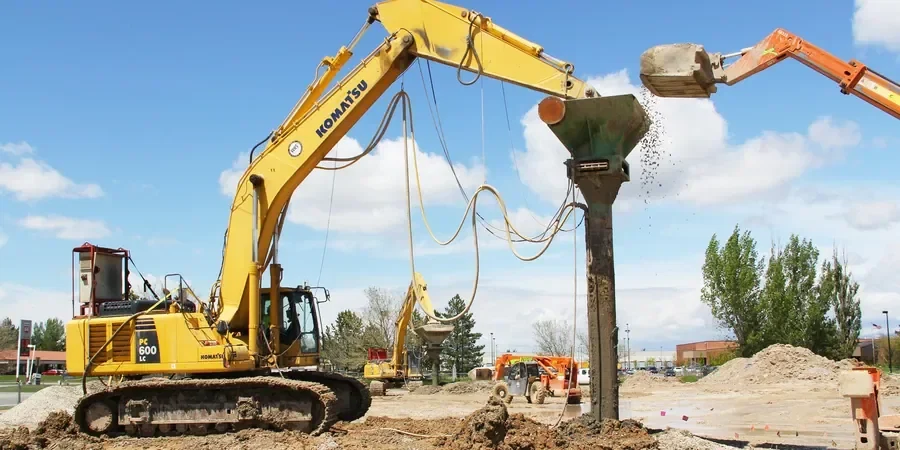
The types of projects that require ground improvement in Wolverhampton are diverse. Residential developments on former industrial land frequently need stone column design to support lightly loaded slabs and reduce total and differential settlement in soft clays. Large commercial and logistics warehouses, often with high floor loadings and strict settlement tolerances, benefit from vibrocompaction design to densify loose granular fills and natural sands, increasing bearing capacity and stiffness. Infrastructure works, such as road embankments, bridge approaches, and flood defence schemes, also rely on these techniques to mitigate consolidation settlement and improve slope stability. Even smaller projects like school extensions or retaining walls may require a form of improvement to manage variable ground and avoid deep, expensive piled solutions.
Available services
Common questions
What is ground improvement and when is it necessary?
Ground improvement is the process of modifying the physical properties of soil to enhance its strength, stiffness, and permeability for construction. It becomes necessary when site investigation reveals weak, loose, or compressible soils that cannot safely support proposed loads without excessive settlement or risk of failure, making traditional foundations impractical or uneconomical.
How do I know which ground improvement technique is right for my Wolverhampton site?
The choice depends on the soil type, depth of treatment required, and structural loading. Cohesive soils like soft clays often respond well to stone columns for reinforcement and drainage, while loose granular soils are ideal for vibrocompaction to increase density. A detailed ground investigation and geotechnical analysis are essential to select the most effective and cost-efficient method.
What are the key UK regulations governing ground improvement works?
Ground improvement design is governed by BS EN 1997-1 (Eurocode 7) and its UK National Annex, which mandate limit state design and rigorous verification. Execution standards such as BS EN 14731 for deep vibration also apply. All projects must adhere to the CDM 2015 Regulations for health and safety, and the ICE Specification for Ground Treatment is commonly used for quality control.
What are the main benefits of ground improvement over traditional piling?
Ground improvement often provides a more sustainable and economical solution by treating the ground in situ, eliminating the need to import large quantities of fill or concrete. It can be faster to install, reduces spoil removal, and minimises the carbon footprint. For large-area treatments like floor slabs and embankments, it typically offers significant programme and cost advantages compared to deep piling.
Location and service area
We serve projects across Wolverhampton and surrounding areas.