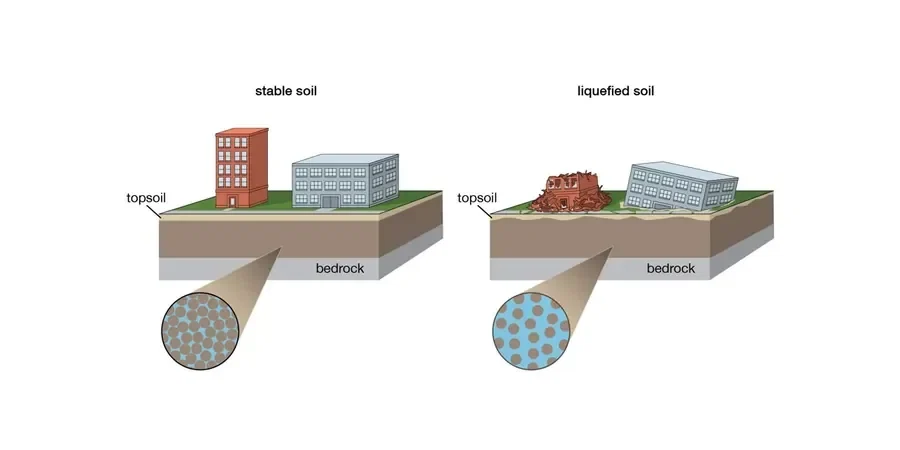
Wolverhampton’s built fabric owes much to its 19th-century industrial expansion, where heavy engineering works and dense brick housing were laid directly over the Permo-Triassic sandstone and overlying Quaternary drift. What many site investigations miss, however, is that pockets of water-bearing sand within the glacial till and recent alluvium along the Smestow Brook can, under the right seismic conditions, become susceptible to soil liquefaction analysis. While the West Midlands sits in a region of low seismicity, a magnitude 4.7 event near Dudley in 2002 reminded engineers that dormant faults still exist. In our background, combining a CPT test with selective sampling provides a far more reliable measure of cyclic resistance than SPT data alone in these transitional ground profiles, especially where the water table sits within three metres of formation level.
A silt-rich sand that looks competent in a trial pit can still lose over 60% of its effective stress during a moderate earthquake. Liquefaction is a function of drainage, not just density.
Method and coverage
Key aspects we routinely evaluate include:
- Cyclic stress ratio (CSR) adjusted for depth and water table position
- Cyclic resistance ratio (CRR) derived from normalised CPT tip resistance or SPT N60 values
- Fines content correction and its effect on CRR
- Liquefaction Potential Index (LPI) mapped across the site footprint
- Volumetric strain and post-shaking settlement estimates
Regional considerations
One recurring error on brownfield sites across the Black Country is assuming that the stiff glacial till acts as a complete seismic cap, leading to a decision to omit soil liquefaction analysis from the ground investigation scope. When a thin sand lens is encountered within the till—often perched and pressurised—it can liquefy and cause a sudden loss of bearing beneath shallow footings, even under shaking that a structure in Birmingham might survive without issue. The Smestow Valley corridor, with its buried channel sands, is particularly prone to this scenario. We have seen projects where piling through the liquefiable layer without design for downdrag led to unacceptable differential settlement within the first five years. A properly integrated slope stability check also becomes relevant where a liquefied layer daylights on a canal embankment or railway cutting, a situation not uncommon near the Birmingham Canal Navigations that thread through Wolverhampton.
Process video
Standards that apply
BS 5930:2015+A1:2020 – Code of practice for ground investigations, BS EN 1998-5:2004 (Eurocode 8, Part 5) – Foundations, retaining structures, and geotechnical aspects, including liquefaction, PD 6698:2009 – UK National Annex recommendations for seismic design to Eurocode 8
Related services
CPT-Based Liquefaction Screening
Continuous cone penetration testing with pore-pressure measurement to capture thin sand seams that standard SPT intervals can miss. We process the raw CPTu data using Robertson charts and normalised parameters to calculate CRR and factor of safety per metre depth.
Post-Liquefaction Settlement Analysis
Quantitative volumetric strain assessment following the Ishihara-Yoshimine framework, integrated with the geotechnical model. The output gives the structural engineer a map of expected ground surface settlement under the design earthquake.
Improvement Feasibility Assessment
Where the factor of safety falls below 1.1, we evaluate the practical viability of vibrocompaction, stone columns, or rigid inclusions in Wolverhampton’s mixed drift, providing performance specifications and post-treatment verification criteria.
Typical parameters
Top questions
Is a soil liquefaction analysis mandatory for small residential developments in Wolverhampton?
It depends on the ground conditions, not the building size. If the site investigation reveals loose to medium-dense saturated sands within 15 metres of the surface, Eurocode 8 requires the engineer to at least screen for liquefaction. In the Trent Valley and Smestow Brook drift deposits, we often recommend a screening-level analysis even for two-storey housing.
How do you determine the design earthquake magnitude for a Wolverhampton site?
We use the UK seismic hazard model from the British Geological Survey, combined with the return period specified in BS EN 1998-1 and its National Annex. For normal structures, this usually corresponds to a reference peak ground acceleration around 0.02g to 0.04g on rock, scaled to a magnitude 5.5–6.0 event for liquefaction assessment.
What is the typical cost range for a soil liquefaction analysis in Wolverhampton?
For a standalone analysis based on existing CPT or SPT data from a single residential plot, the fee typically falls between £2,220 and £3,410. The exact cost depends on the number of critical profiles, the complexity of the stratigraphy, and whether post-liquefaction settlement calculations are required.
Can you perform the analysis if we only have SPT data and no CPT soundings?
Yes, though the resolution is lower. We can correlate SPT N-values to equivalent clean-sand tip resistance using energy and overburden corrections per NCEER guidelines. However, we will flag the higher uncertainty and, for sites with marginal factors of safety, usually recommend supplementary CPT soundings to refine the cyclic resistance profile.