The Black Country's industrial past left Wolverhampton sitting on layers of glacial till, alluvial clays, and weathered Coal Measures that make soft ground tunnelling a proper headache. You can drill a borehole near the city centre and hit stiff boulder clay, then move half a mile towards the Smestow Valley and find saturated silts that barely hold a bore. We have been dealing with this patchwork for years, running triaxial consolidated undrained tests and oedometer swelling pressure runs to give tunnel designers numbers they can actually use. Getting the undrained shear strength profile right matters when your TBM is passing under the Birmingham Canal Navigations—dewatering isn't always an option and face stability calculations depend on knowing whether you have 40 kPa or 80 kPa at tunnel axis. Our triaxial testing programme includes stress paths that replicate excavation unloading, and we pair that with in-situ permeability tests using packer systems in standpipes to quantify leakage into the heading. More often than not, the critical section isn't where the borehole log shows the softest clay—it's where the CPT test reveals a thin sand lens nobody expected.
Undrained shear strength alone won't save a tunnel face in Wolverhampton's glacial till—you need the consolidation coefficient from oedometer tests to predict how fast pore pressures equalise after each advance.
Method and coverage
Regional considerations
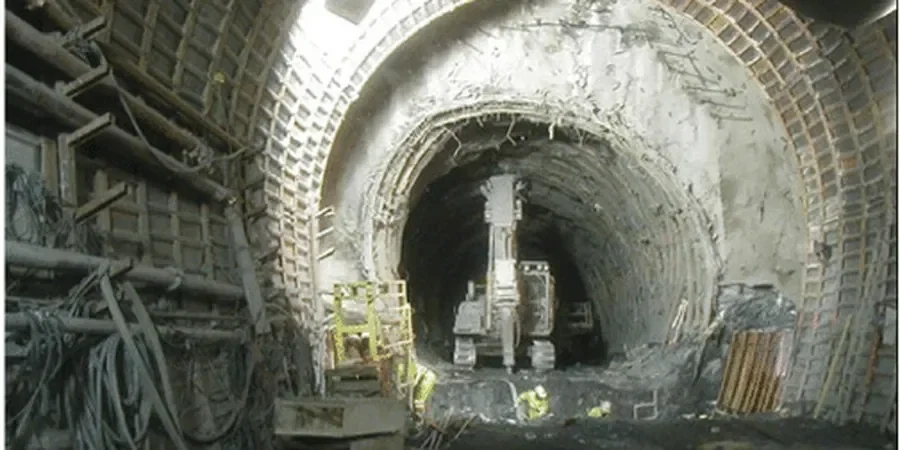
The glacial till across Wolverhampton sits on Carboniferous Coal Measures that have been mined for two hundred years, and the 1873 mining atlas shows workings under parts of the city centre that were never backfilled systematically. You can hit a void at crown level that doesn't appear on any abandonment plan, and the sudden loss of confinement combined with groundwater inflow turns a stable face into a running ground condition in under a minute. Even where the till is intact, the presence of sandstone bands within the mudstone creates perched water tables that piezometers often miss if the response zone isn't sealed properly. We have seen pore pressures spike 30 kPa above hydrostatic during rapid drawdown events near the Smestow Brook, and that changes the effective stress regime enough to trigger face instability in an otherwise conservative design. The BS EN 1997-1:2004 design approach 1 combination 2 requires you to factor the water pressure independently from the soil weight, and in Wolverhampton's layered geology that means the critical case is rarely the one you assumed at tender stage.
Standards that apply
BS 5930:2015+A1:2020 – Code of practice for ground investigations, BS EN 1997-1:2004 – Eurocode 7: Geotechnical design – General rules, BS 1377-7:1990 – Methods of test for soils: Shear strength tests (triaxial), BS EN ISO 17892-9:2018 – Geotechnical investigation: Consolidated triaxial compression tests, BS 1377-2:1990 – Classification tests (Atterberg limits, particle density), CIRIA C760 – Guidance on embedded retaining wall design
Related services
Advanced triaxial stress path testing
Consolidated undrained and drained triaxial tests with local strain instrumentation, run along stress paths that replicate the unloading sequence a TBM excavation imposes. We report effective stress strength envelopes and stiffness degradation curves that feed directly into PLAXIS 3D or FLAC3D models.
Oedometer consolidation and swelling tests
Incremental loading oedometer tests to determine cv, mv, and the preconsolidation pressure from Casagrande or Pacheco Silva methods. Swelling pressure runs on Mercia Mudstone samples under constant volume conditions to quantify long-term lining loads.
In-situ permeability and packer testing
Falling head and constant head tests in standpipe piezometers, plus double packer tests in rockhead to isolate permeability in sandstone bands within the Coal Measures. Essential for dewatering design and TBM face pressure specification.
Soil conditioning and foam optimisation studies
Laboratory mixing tests with EPB conditioning agents, measuring foam stability and slump under the specific moisture content and fines percentage of Wolverhampton's glacial till. We calibrate FIR and polymer dosage so the muck comes out like toothpaste, not soup.
Typical parameters
Top questions
How do you handle boulders and cobbles in Wolverhampton's glacial till during a tunnel drive?
The till across the West Midlands commonly contains sub-rounded quartzite cobbles up to 300 mm and occasional boulders exceeding 500 mm, particularly along the M54 corridor towards Cannock. We run particle size distribution tests on bulk samples from trial pits and sonic drilling to quantify the cobble frequency and maximum particle size, which feeds directly into TBM cutterhead design and the decision between a slurry versus EPB machine. If the cobble content exceeds 15% by mass, we typically recommend a mixed-face cutterhead with disc cutters and a crusher on the screw conveyor.
What is the typical cost range for a geotechnical investigation supporting a soft ground tunnel in Wolverhampton?
For a tunnel project in Wolverhampton, a site investigation programme including boreholes, sampling, In-Situ, and the full laboratory suite we have described usually falls between £3,540 and £13,420 depending on the length of the drive, the depth of the tunnel, and how many boreholes are needed to satisfy the spacing requirements in BS 5930:2015 for linear infrastructure. Ground investigation is typically 0.5% to 1.5% of the total tunnel construction cost, and under-investing at this stage is the most expensive mistake you can make on a soft ground project.
Do you test for swelling pressures in the Mercia Mudstone, and why does it matter for tunnels?
We do, and it matters a lot. The Mercia Mudstone Group underlies much of Wolverhampton's city centre and, when weathered, contains smectite clay minerals that can develop swelling pressures between 30 and 300 kPa upon rehydration after excavation. If you don't measure this during the investigation and factor it into your segmental lining design, you will see cracking in the invert within the first five years of operation. We run constant-volume swelling tests according to BS 1377-5:1990 and compare the results against the overburden pressure at tunnel crown to determine whether a fully closed invert lining is required.