In Wolverhampton, the legacy of heavy industry has left a patchwork of made ground and variable natural soils across the city. When we run a laboratory CBR test on samples from sites near the old steelworks or around Wednesfield, the data often reveals unexpected weak spots that a simple visual inspection misses. The California Bearing Ratio (CBR) test gives us a direct measure of soil strength, essential for pavement thickness design. Whether the project involves a new access road in Bilston or resurfacing the A449, the CBR value determines how thick the sub-base and bituminous layers need to be. We complement this with a grain size analysis to confirm fines content, which heavily influences the CBR result, and a Proctor test to establish the compaction reference density before any strength assessment begins.
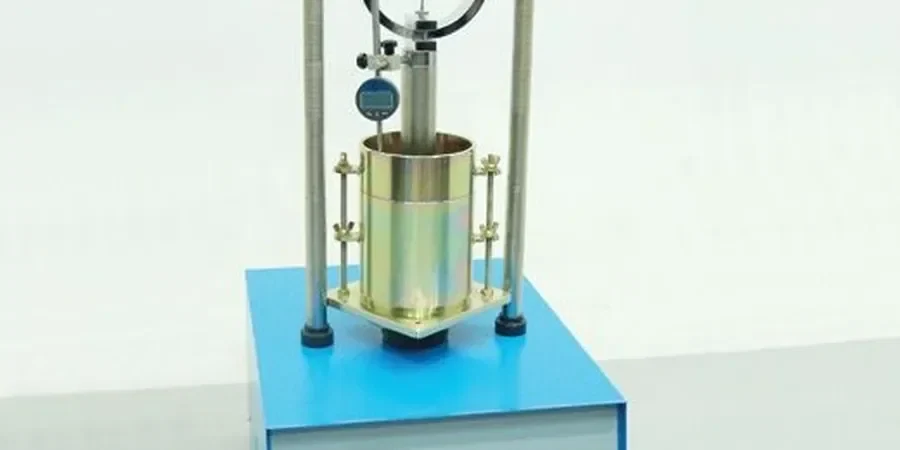
A soaked CBR test reveals the true post-construction strength of a subgrade — the difference between a dry and soaked value can be dramatic in Wolverhampton's clay-rich soils.
Method and coverage
Regional considerations
Wolverhampton's annual rainfall, averaging around 750 mm, makes moisture sensitivity the single biggest risk for pavement performance. Clay subgrades in areas like Compton and Finchfield can swell and lose significant bearing capacity when saturated. A laboratory CBR test that only reports a dry or unsoaked value gives a false sense of security. The soaked CBR protocol is not optional here — it is essential. We have seen cases where a subgrade dropped from a CBR of 8% dry to under 2% soaked, completely altering the pavement design from a standard flexible construction to a heavily reinforced one. This risk is compounded by the city's freeze-thaw cycles in winter, which can heave waterlogged layers. Without proper laboratory characterisation, the pavement will rut and crack within the first two years, triggering costly maintenance and traffic disruption on key routes like the Ring Road.
Standards that apply
BS 1377-4:1990 — Soils for civil engineering purposes. Compaction-related tests, BS EN 13286-47:2012 — Unbound and hydraulically bound mixtures. Test method for CBR, Manual of Contract Documents for Highway Works (MCHW), Series 600 — Earthworks, Design Manual for Roads and Bridges (DMRB), CD 225 — Design for new pavement construction
Related services
Soaked and Unsoaked CBR Determinations
We test specimens compacted in CBR moulds at Proctor density, with a standard 96-hour soak for cohesive soils to replicate the worst in-service moisture condition beneath impermeable pavements.
Moisture Condition Value (MCV) and Compaction Verification
We establish the relationship between moisture content and compactability, critical for earthworks acceptance on projects following the MCHW Series 600 specification.
Pavement Thickness Design Inputs
We generate the CBR design value for use in DMRB CD 225 calculations, helping you specify the correct sub-base and asphalt layer thicknesses for residential roads, industrial yards, and highway schemes.
Typical parameters
Top questions
What is the cost of a laboratory CBR test in Wolverhampton?
A standard laboratory CBR test, including compaction at Proctor optimum and a 96-hour soak, typically ranges between £100 and £150 per specimen. The exact cost depends on the number of points on the compaction curve needed beforehand. Contact our Wolverhampton lab for a project-specific quote.
How long does it take to get CBR results?
A dry or unsoaked CBR can be reported within 2-3 working days. However, if a soaked CBR is required — which is standard for cohesive subgrades in Wolverhampton — the 96-hour soaking period extends the turnaround to about 7 working days from sample receipt.
Is the CBR test suitable for granular sub-base materials?
Yes, the CBR test is routinely used for Type 1 and Type 2 sub-base materials, as well as crusher-run. We follow BS EN 13286-47 and compact the granular material in a CBR mould at optimum moisture content. For granular layers, the 2.5 mm penetration value usually governs the reported CBR.
What is the difference between a field CBR and a laboratory CBR?
A field CBR test, or plate bearing test, measures the in-situ strength but is highly sensitive to moisture and density variations at the time of testing. A laboratory CBR allows us to control compaction and moisture precisely, and to test the soil in its weakest soaked state. For design purposes, the laboratory soaked CBR is the definitive value per DMRB CD 225.
What sample quantity is needed for a CBR test?
We typically need around 25 kg of disturbed bulk sample to run a CBR test along with the associated Proctor compaction curve. For fine-grained soils, a 20 kg bag is often sufficient. The sample should be sealed immediately after excavation to preserve its natural moisture content.