One of the costliest mistakes we see on Wolverhampton sites is treating vibro stone columns as a one-size-fits-all solution without proper design. You can't just guess the spacing and hope the settlement stays within tolerance. The town sits on a patchwork of Permian and Triassic sandstones, but the real trouble comes from the alluvial deposits along the Smestow Brook and the River Tame corridors. These soft silts and peats compress unevenly under load, and a poorly designed column grid either wastes aggregate or fails to transfer stress to the competent strata. We approach each job by first characterising the weak layer with in-situ tests, then running settlement analyses under the actual foundation loads. Often we combine the design with a CPT test to map the thickness of the compressible layer continuously before selecting the column length and diameter.
If the stone column does not penetrate the full thickness of the soft layer, you are just creating a stiffer raft inside a bathtub of compressible soil.
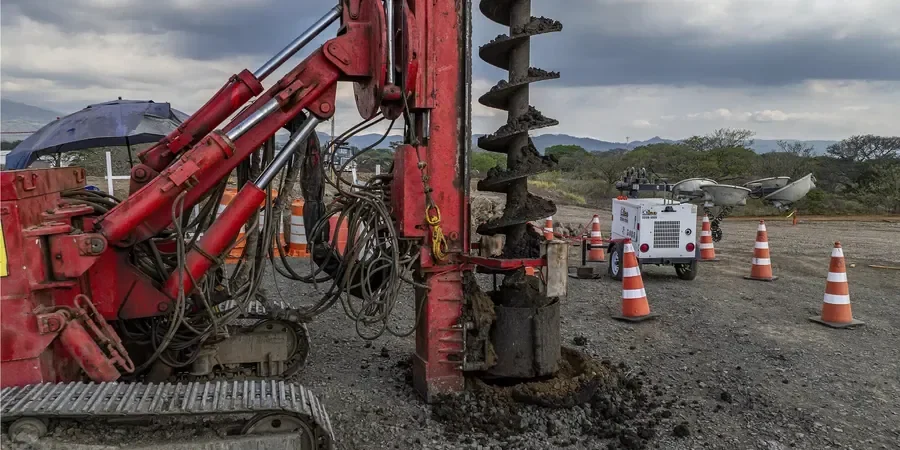
Method and coverage
We then cross-check the bearing capacity and the settlement reduction factor. For warehouse slabs on soft ground, the critical parameter is usually differential settlement, not total settlement. Our lab tests the imported stone for particle size distribution and Los Angeles abrasion to confirm it will not crush under the vibroflot energy, because crushed aggregate loses drainage capacity over time.
Regional considerations
BS EN 1997-1:2004 (Eurocode 7) requires a ground investigation report that explicitly covers the design assumptions for any Improvement technique. In Wolverhampton, where former coal mining and backfilled marl pits are scattered across the urban area, the risk of encountering unmapped voids or collapsible fill is higher than many contractors expect. A stone column installed over a void simply drains aggregate into the cavity, leaving a soft spot under the foundation. We have seen site investigation reports that relied solely on trial pits and missed a 2-metre-deep pocket of peat at 4 metres depth. For stone column design, the investigation must go at least 5 metres below the column toe, per BS 5930 recommendations. Without that, you are loading a composite block that can punch into an undetected weak horizon. The cost of remedial underpinning later dwarfs the cost of a proper ground model upfront.
Standards that apply
BS EN 1997-1:2004 (Eurocode 7: Geotechnical design), BS 5930:2015 (Code of practice for ground investigations), BS EN 14731:2005 (Execution of special geotechnical works – Ground treatment by deep vibration)
Related services
Site investigation for stone columns
CPT, SPT and sampling campaigns through the soft layer, with laboratory classification and strength testing to build the ground model required by Eurocode 7.
Settlement and bearing capacity analysis
Unit cell calculations (Priebe method) and 2D axisymmetric finite element models to predict total and differential settlement under service loads.
Grid layout and column specification
Triangular or square grids with defined diameter, depth, area replacement ratio and stone gradation, prepared for the specialist vibroflot contractor.
Post-treatment verification testing
Plate load tests, zone CPTs and multi-channel surface wave testing to confirm the composite modulus meets the design target before slab construction.
Typical parameters
Top questions
How much does a stone column design package cost for a typical Wolverhampton site?
For a standard commercial or industrial plot, the design package ranges from £1,230 to £3,560 depending on the treated area, the number of investigation points required, and whether finite element modelling is needed alongside analytical calculations.
What ground conditions in Wolverhampton make stone columns suitable?
Stone columns work well in the soft alluvial silts and clays found along the Smestow Brook and Tame valleys, where undrained shear strengths are below 40 kPa and the natural soil cannot support shallow footings or slabs without excessive settlement.
How deep can stone columns be installed in Wolverhampton?
Using wet top-feed vibroflot rigs, we typically design columns up to 20 metres deep. The limiting factor is usually the depth to competent sandstone bedrock, which across Wolverhampton varies from 5 to over 25 metres depending on the drift thickness.
What laboratory tests do you run on the stone fill?
We test the proposed aggregate for particle size distribution (BS EN 933-1), Los Angeles abrasion (BS EN 1097-2) and flakiness index. Angular, well-graded gravel with LA below 30% performs best under vibro compaction and maintains long-term drainage.
How do you verify the columns work after installation?
We specify zone CPT tests between columns to measure the increase in tip resistance, plus plate load tests on single columns and column groups. For large sites, we also run MASW surveys to map the shear wave velocity improvement across the entire treated area.