The ground beneath Wolverhampton tells a long industrial story. Former mining works, backfilled marl pits, and century-old foundry waste have left a patchwork of loose, compressible fills that standard foundations simply cannot trust. When a site investigation flags relative densities below 35% or SPT N-values under 8 across the upper five metres, we move straight into vibrocompaction design. The goal is not just densification on paper. It is delivering a treated mass where allowable bearing pressure climbs from marginal to at least 150 kPa, verified in the field. In the Black Country, where redevelopment pressure keeps pushing projects onto marginal land, a properly engineered compaction scheme is the difference between a buildable plot and a costly over-excavation. Where fills are granular and the water table permits, we often pair the design work with a CPT test programme before and after treatment, giving the client a continuous resistance profile that leaves no room for interpretation.
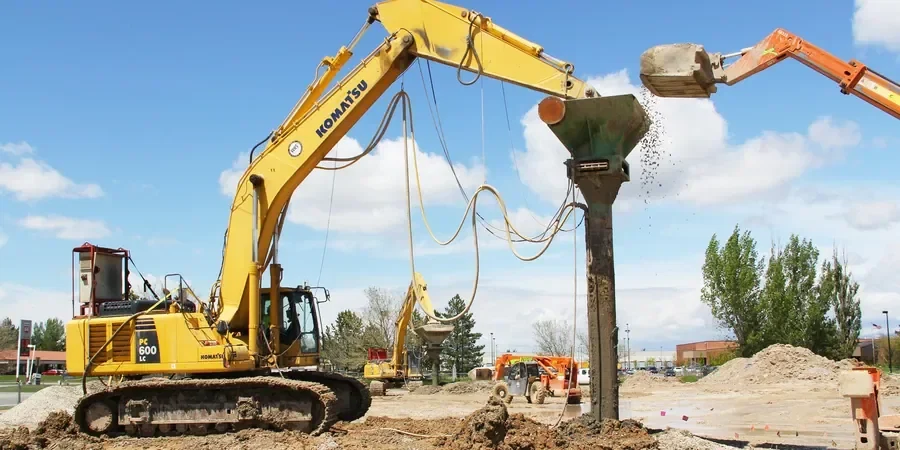
When loose made ground exceeds three metres in depth, vibrocompaction design transforms a marginal building platform into a competent bearing stratum without the carbon cost of dig-and-replace.
Method and coverage
Regional considerations
Wolverhampton sits on the western edge of the South Staffordshire Coalfield, and although deep mining has ceased, the legacy of shallow pillar-and-stall workings and unrecorded shafts persists beneath many development sites. Vibrocompaction in this context carries a specific risk: if the treatment encounters a void or collapsed mine entry, the energy dissipates unpredictably and densification becomes ineffective, while the vibration itself could trigger further collapse. The city's variable drift cover, sometimes as thin as two metres over Coal Measures sandstone, demands a design that cross-references the Coal Authority mine entry database and historical abandonment plans before the grid is fixed. Another factor is the winter groundwater rise common across the Severn-Trent catchment, which can saturate fills and reduce the effectiveness of dry bottom-feed methods. Our risk assessment for every Wolverhampton job therefore includes a mine-shaft buffer zone, a wet-weather contingency for the treatment window, and a requirement for pre-treatment probing in any area where historical maps show a shaft within 30 metres of the site boundary.
Standards that apply
BS EN 1997-1:2004 (Eurocode 7) — Geotechnical design, Improvement as designed element, BS EN 14731:2005 — Execution of special geotechnical work: ground treatment by deep vibration, BS EN ISO 22476-1:2012 — CPT as verification method for compaction acceptance, BS 5228-2:2009 — Code of practice for noise and vibration control on construction sites, ICE Specification for Ground Treatment (2nd edition, 2020) — Method specification and acceptance criteria
Related services
Ground Investigation and Soil Characterisation
Review of existing borehole logs, window samples, and CPT data to classify the fill and natural strata, identify obstructions, and determine the depth of treatment required for the target bearing capacity.
Vibrocompaction Scheme Design and Method Statement
Production of EC7-compliant design drawings showing grid layout, vibroflot type, depth, backfill specification, and sequence. Includes a method statement with environmental controls tailored to the Black Country urban context.
Post-Treatment Verification and Sign-off
Supervision of verification testing using CPT, zone load tests, or plate bearing tests, with a final report that confirms compliance with the design acceptance criteria and provides the basis for the foundation design.
Typical parameters
Top questions
What does vibrocompaction design typically cost for a Wolverhampton site?
For a typical plot in Wolverhampton with loose made ground, the design package including ground model review, grid design, method statement, and verification planning generally falls between £1,140 and £3,900, depending on the complexity of the ground conditions and the number of treatment zones. If additional pre-treatment CPT soundings or mine entry investigations are needed, those are costed separately.
How deep can vibrocompaction treat the loose fills common in the Black Country?
With the equipment we specify, treatment can reach depths of 8 to 10 metres in granular fills, which covers most of the made ground thicknesses encountered across Wolverhampton. For deeper fills exceeding 10 metres, we would assess whether a combination with stone columns or a different Improvement technique would be more appropriate.
Is vibrocompaction safe to use near existing buildings in Wolverhampton's terraced streets?
Vibration control is a core part of the design. We set a peak particle velocity limit of 5 mm/s at the nearest sensitive structure, based on BS 5228-2, and specify monitoring with triaxial geophones on the building line. If the design cannot maintain this limit at the required grid spacing, we adjust the sequence or switch to a lower-energy method for the perimeter points.
How long does the design and approval process take before site work can begin?
Once the ground investigation data is complete, the design package can usually be produced within two to three weeks. If the scheme requires Coal Authority consultation due to recorded mine entries, we allow an additional week for that process. The verification testing programme is written into the design so that the sign-off criteria are agreed before any rig arrives on site.