BS 5930 and Eurocode 7 (BS EN 1997-2:2007) leave no room for guesswork when it comes to fine-grained soils, and in Wolverhampton that means dealing with the glacial tills and alluvial silts of the West Midlands. Our laboratory runs Atterberg limit determinations – liquid limit, plastic limit, and the derived plasticity index – to classify exactly how a cohesive soil will behave under changing moisture. With the city sitting on a mix of Devensian till over Triassic sandstone, the clay fraction can vary dramatically from one site to the next, even across a single postcode. We see this regularly on projects around Bushbury and Tettenhall, where a few metres of stiff boulder clay can overlie weathered mudstone, making routine classification essential before any foundation or earthworks design moves forward. For deeper profiling we often pair these results with SPT drilling to correlate plasticity data with in-situ density and strength.
A plasticity index above 20% in Wolverhampton's glacial tills is a clear signal to revisit drainage and foundation depth assumptions.
Method and coverage
Regional considerations
A residential extension in the Whitmore Reans area sticks in our memory. The ground investigation encountered a layer of silty clay with a liquid limit of 62% and a plasticity index of 35%, sitting barely a metre below the proposed strip footing. The contractor had assumed a stiff till and planned for a standard 900 mm depth. When we ran the Atterberg tests and plotted the results on the Casagrande plasticity chart, the soil fell squarely in the high-plasticity clay zone – the kind of material that swells significantly in winter and shrinks in summer, exerting differential movement on shallow foundations. The design had to change: the footings were deepened to 1.8 metres and a suspended floor was introduced to create a void against heave. Without that classification data, the building would have been chasing cracks within three seasons. In a city where the geology shifts from sandstone to glacial drift over short distances, skipping the plasticity assessment can turn a straightforward project into a long-term liability.
Standards that apply
BS EN ISO 17892-12:2018 – Liquid and plastic limit determination, BS 5930:2015+A1:2020 – Code of practice for ground investigations, BS EN 1997-2:2007 (Eurocode 7) – Ground investigation and testing
Related services
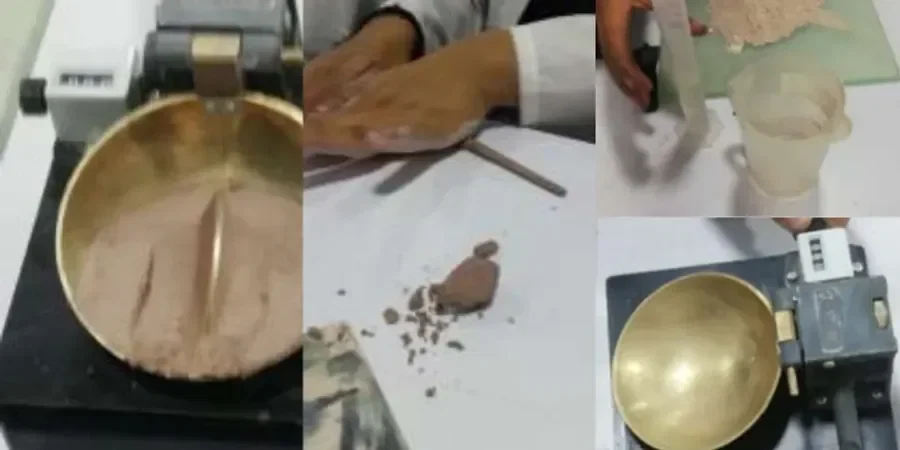
Liquid Limit by Fall Cone
Determination of the moisture content at which remoulded soil transitions from plastic to liquid behaviour, using the 80 g / 30° cone method specified in BS EN ISO 17892-12.
Plastic Limit & Plasticity Index
Thread-rolling procedure to establish the plastic limit, combined with the liquid limit to calculate the plasticity index for classification on the Casagrande chart.
Shrinkage Limit & Volumetric Assessment
Measurement of the shrinkage limit to evaluate the potential for volume change in clay soils, particularly relevant for sites on Wolverhampton's glacial drift deposits.
Typical parameters
Top questions
How much does Atterberg limits testing cost in Wolverhampton?
For a standard set of Atterberg limits – liquid limit by fall cone plus plastic limit – our laboratory pricing in the Wolverhampton area typically falls between £50 and £90 per sample, depending on the number of specimens in the batch and the turnaround time required. If you need the full shrinkage limit or liquidity index calculated as well, we can quote a package rate once we know the sample count and site conditions.
How long does it take to get Atterberg limits results?
Standard turnaround is three to four working days after the sample arrives at our lab, provided the material is in good condition and we do not need to re-dry or re-prepare it. For urgent projects we can expedite to 24–48 hours by prior arrangement – common on fast-track residential schemes in Wolverhampton where the foundation design is waiting on soil classification data.
Can you test samples taken from shallow hand-dug pits or only from boreholes?
We routinely test samples from both sources. What matters is the quality of the sample, not the excavation method. Bag samples from a hand-dug inspection pit near the surface are perfectly suitable for Atterberg limits, as long as they have been sealed immediately to preserve natural moisture. For deeper clays we recommend combining the plasticity data with SPT or undisturbed tube samples to get a complete picture of the ground profile across Wolverhampton's variable drift geology.