The Triassic sandstone and Mercia Mudstone that sit beneath Wolverhampton weather into silty, slightly cohesive soils that can be a pain to compact properly. If you're working on a site near the Ring Road or out towards Bilston, you'll know the red-brown glacial till appears solid in the dry but turns to slurry after a week of Midlands rain. We run field density tests across the city to check that what the roller puts down actually meets spec. The sand cone method, done to the letter of BS 1377-9, tells us the in-place dry density right there on the lift. Before opening a trench or placing a footing, it's common to pair this with a test pit investigation to log the fill profile, because Wolverhampton's industrial legacy means made ground is rarely uniform.
A 98% relative compaction figure means nothing without knowing the reference Proctor density of the exact fill material being placed.
Method and coverage
Regional considerations
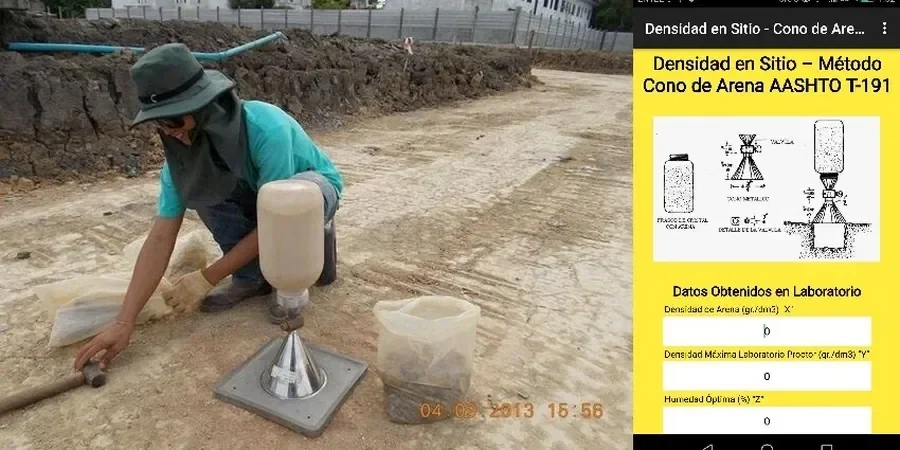
The sand cone apparatus looks simple — a plastic jar, a metal cone, a base plate — but get the procedure wrong and the numbers are worthless. In Wolverhampton's glacial till, the biggest trap is losing material from the excavated hole because the sidewalls crumble. We use a template plate on every test and dig the hole with a spoon and brush, not a spade, to keep the geometry clean. If the fill contains sandstone cobbles larger than 37.5 mm, the sand replacement method overestimates density; in those cases we flag the limitation and may recommend a nuclear density gauge alternative or a large-scale water replacement test. A false pass on compaction here can lead to differential settlement on a housing slab within two winters — and we've seen exactly that on clay-plateau sites near Tettenhall.
Standards that apply
BS 1377-9:1990, BS 5930:2015+A1:2020, Eurocode 7 (BS EN 1997-2:2007), SHW Series 600
Related services
Sand Cone Field Density
In-situ density measurement per BS 1377-9 on earthworks, subgrade, capping, and structural fill lifts across Wolverhampton and the Black Country.
Laboratory Proctor Compaction
Standard and modified Proctor tests (2.5 kg and 4.5 kg rammer) to establish the reference curve for the specific site material.
Plate Load Testing
Static plate load tests per BS 1377-9 to verify bearing capacity and modulus of subgrade or granular platform before pavement construction.
Typical parameters
Top questions
How much does a sand cone density test cost in Wolverhampton?
A single sand cone test on a site within Wolverhampton typically runs between £90 and £110, which includes the technician's time, calibration sand, and the field density report. The rate drops per point if we're doing a full day of testing — say 10 to 15 points across a capping layer — because the travel and setup cost is spread over the volume.
When does the council require sand cone tests on a new estate road?
City of Wolverhampton Council's highways adoption team follows the Specification for Highway Works Series 600, so compaction testing is required on every lift of subgrade, capping, and sub-base. The typical frequency is one density test per 500 m² per layer, though the Section 38 agreement for your specific development may tighten that to one per 250 m² if the ground conditions are variable.
Can you test density in fill that has a lot of brick rubble in it?
It depends on the particle size. The sand cone method works well up to about 37.5 mm, so if the crushed brick and concrete in your Wolverhampton brownfield fill passes a 40 mm screen, we can get reliable results. If there are larger lumps, the excavated hole becomes irregular and the sand replacement volume is less accurate — we'd discuss a large-scale water replacement test or a zone-test approach instead.