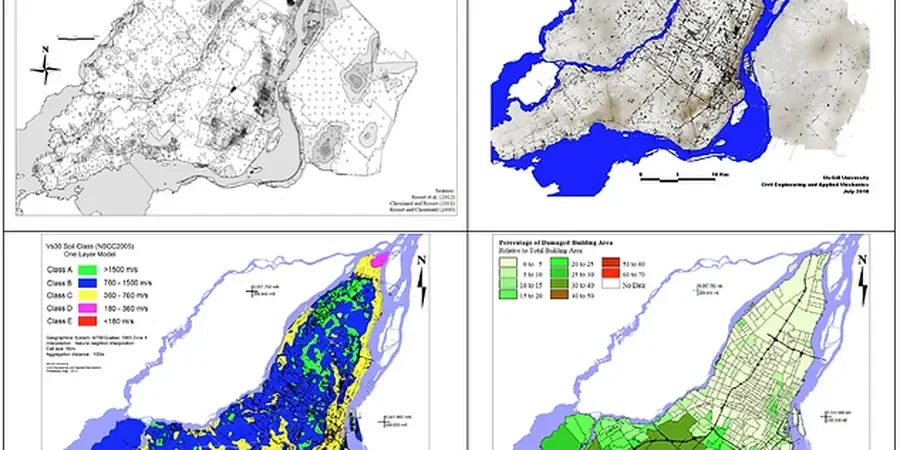
The most persistent error on brownfield sites across Wolverhampton is treating the entire site as uniform ground when seismic hazard actually varies metre by metre due to buried coal measures and variable drift thickness. A generic PGA from a national hazard map misses the amplification that occurs where soft alluvium overlies the Etruria Formation at shallow depth. Our seismic microzonation work resolves this directly: we measure shear-wave velocity profiles across the site, correlate them with the detailed borehole logs required under BS 5930, and produce a grid of site-specific response spectra that the structural engineer can apply zone by zone. For deeper soil columns or sites near the Birmingham Fault's northern extensions, we often combine the MASW survey with CPT testing to capture the small-strain stiffness profile without disturbing the sample fabric.
Seismic microzonation turns a single design spectrum into a contour map: the difference between two boreholes 30 metres apart can be a full site class jump under Eurocode 8.
Method and coverage
Regional considerations
The West Midlands climate introduces a seasonal risk that is easy to overlook in seismic site classification. Heavy winter rainfall saturates the upper 2 to 3 metres of glacial till, temporarily lowering the shear-wave velocity in the near-surface by 10 to 20 percent compared with summer conditions. A microzonation survey conducted in February can place a zone into site class D that would register as class C in August, purely due to pore pressure effects in the vadose zone. We mitigate this by running MASW lines during both wet and dry seasons where the initial screening indicates borderline Vs30 values, and by cross-referencing the velocity profile with CPT pore pressure dissipation tests that reveal the drainage state of the soils at the time of measurement. In areas of former heavy industry north of the city centre, the presence of chemical contaminants that alter pore fluid chemistry adds another variable that standard geophysical interpretation misses without geochemical ground-truthing.
Standards that apply
BS EN 1998-1:2004 (Eurocode 8 – Seismic design), BS 1377 / D7400 (Crosshole & surface wave methods), BS 5930:2015 (Site investigation code of practice)
Related services
Site-Specific Response Spectra for Structural Design
We convert the measured Vs profiles into elastic and design response spectra per BS EN 1998-1 for each microzone, including the effects of local soil damping ratios measured through resonant column testing of undisturbed samples. The output is a set of acceleration, velocity, and displacement spectra that the structural engineer imports directly into ETABS or SAP2000 models.
Liquefaction Susceptibility Screening
Where the microzonation identifies saturated loose granular layers with Vs1 below 200 m/s, we run a parallel liquefaction assessment using the CPT-based method of Boulanger & Idriss (2014). The result is a factor of safety contour map against liquefaction triggering at the design earthquake magnitude, calibrated to the same seismic scenario used in the microzonation.
Typical parameters
Top questions
How does a seismic microzonation differ from a standard site classification report?
A standard site classification assigns one site class to the whole plot based on an average Vs30, often from a single measurement point. A microzonation maps the spatial variation of Vs30, fundamental period, and amplification across the footprint, typically on a 15–50 metre grid. In Wolverhampton, where drift thickness and rockhead depth can change sharply over short distances, a microzonation will often reveal two or three different site classes across a project area that a single-point classification would mask.
What is the typical cost range for a seismic microzonation study in the West Midlands?
For a site of around 0.5 to 2 hectares in the Wolverhampton area, a microzonation study including MASW grid, borehole correlation, and the final contour maps typically falls between £3,360 and £12,380 depending on grid density, access constraints, and whether seasonal repeat surveys are needed. Sites with complex buried topography or suspected mine workings will be at the upper end due to the heavier borehole control required.
Can the microzonation reduce the seismic design loads compared with using the default site class?
It can, and that is often the economic driver for commissioning one. Many Wolverhampton sites sit on stiff glacial till that plots as site class B under BS EN 1998-1, whereas the default conservative assumption in the absence of data is often class D. The reduction in the design spectrum plateau from class D to class B can lower base shear by 20–30 percent, which flows directly into smaller foundation elements and less reinforcement. The microzonation provides the defensible documentation the building control reviewer needs to accept that reduction.