Wolverhampton’s expansion from a Saxon market town into a heavy-industry hub left a subsurface full of surprises. The Triassic sandstone that underpins much of the city centre is strong in outcrop but riddled with historic coal and ironstone workings that criss-cross beneath Victorian terraces and post-war redevelopments. Overlying glacial till, often stiff and gravelly, adds to the variability that any retaining wall design must accommodate within a few metres of plan. Our team combines desk-study mining records with targeted test pits to verify the boundary between weathered sandstone and competent rock before fixing wall geometry, because assuming uniform ground conditions here has led to over-excavation costs and service clashes on more than one city-centre project.
A retaining wall in Wolverhampton’s mine-worked sandstone is a ground-interaction problem first and a concrete section second.
Method and coverage
Regional considerations
Wolverhampton sits on a low plateau roughly 120 metres above sea level, drained by the Smestow Brook and the Staffordshire canal network. That elevated position keeps groundwater levels moderate in summer, but winter recharge through fissured sandstone can raise the phreatic surface by over a metre in a matter of weeks. A retaining wall designed without adequate weep-holes or a continuous gravel drain behind the stem will trap water, build up hydrostatic pressure, and start tilting before the first hard frost arrives. Mine entries add another layer of uncertainty: a partially collapsed adit just behind the wall line can create a void that concentrates earth pressure in ways no standard Boussinesq distribution captures. Our risk assessment therefore includes a mining report from the Coal Authority, a groundwater monitoring plan through at least one wet season, and a sensitivity analysis that varies the water table and the fill friction angle simultaneously to identify the combination that governs the section.
Standards that apply
BS EN 1997-1:2004 (Eurocode 7 – Geotechnical design), BS 8002:2015 (Code of practice for earth retaining structures), BS 5930:2015 (Code of practice for ground investigations), CIRIA C760 (Guidance on embedded retaining wall design)
Related services
Cantilever and gravity wall design
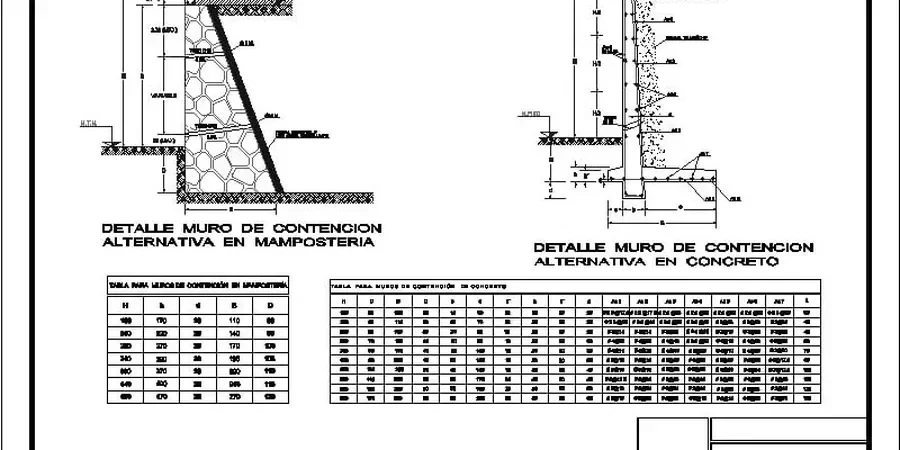
Reinforced concrete cantilever and mass gravity walls for residential cuttings, commercial basements, and highway embankments. The design integrates laboratory shear-strength data from the glacial till or weathered sandstone and checks all ultimate and serviceability limit states per BS EN 1997.
Embedded retaining wall analysis
Secant and contiguous pile walls for deep excavations adjacent to sensitive structures in Wolverhampton city centre. Soil-structure interaction is modelled with WALLAP or Plaxis, using stiffness parameters calibrated against SPT and pressuremeter data, and the output is verified against the CIRIA C760 framework.
Gabion and crib wall specification
Flexible retaining solutions for Brownfield sites and canal-side developments. The design accounts for the aggressive sulphate environment common in Black Country made ground and specifies durable rockfill and geotextile filters in line with BS 8002 and CIRIA guidance.
Typical parameters
Top questions
How much does retaining wall design cost for a project in Wolverhampton?
The design fee for a retaining wall in Wolverhampton typically falls between £750 and £3,050, depending on the wall height, complexity of the ground model, and the level of approval required. A simple cantilever wall under 2 metres on a domestic plot sits at the lower end, while an embedded wall supporting a highway or basement next to a listed building moves toward the upper end because of the additional analysis and third-party checking.
What ground investigation data do you need before starting the design?
We need a site-specific ground investigation that provides SPT N-values, laboratory classification (Atterberg limits and particle size distribution), and shear strength parameters from triaxial or direct shear tests on undisturbed samples. For sites in Wolverhampton’s mine-affected areas, a Coal Authority mining report and rotary open-hole logs to prove competent rock are also essential.
Can you design retaining walls on Brownfield land with contaminated fill?
Yes, Brownfield sites are common across Wolverhampton. We specify concrete mixes with sulphate-resisting cement and apply additional durability requirements per BS 8500. The earth-pressure calculations use conservative parameters for the made ground, and we design the drainage system to prevent leachate build-up behind the wall.
What is the typical design programme for a retaining wall?
A straightforward cantilever wall design can be completed in two to three weeks once the ground investigation report is finalised. Embedded wall designs that require soil-structure interaction modelling and third-party technical approval typically take four to six weeks, depending on the review cycle with the local authority or Network Rail.