The ground beneath Wolverhampton changes character in the space of a few hundred metres. A retaining wall near the sandstone outcrops of Tettenhall faces completely different demands than an excavation in the alluvial clays around Wednesfield. One side of the city sits on Triassic Sherwood Sandstone, the other on Carboniferous Coal Measures with bands of mudstone and siltstone that have shaped the local mining legacy. A single anchor design approach simply does not work here. Where the sandstone provides dependable bond strength, the weathered mudstones require a far more conservative grout-to-ground assumption, and the shallow water table in the Smestow Valley adds its own complications. Before committing to excavation depths or permanent retaining structures, the liquefaction potential in saturated silts and the slope stability of nearby cuttings must be understood—two factors that directly influence whether an active or passive anchoring strategy is chosen.
In Wolverhampton's glacial till, passive anchors often outperform prestressed active systems where cobbles and boulders create unpredictable grout bulbs during installation.
Method and coverage
Regional considerations
Under BS EN 1997-1:2004, anchor design in Wolverhampton must account for a particularly local risk: the presence of unmapped shallow mine workings in the Middle and Upper Coal Measures. Even where a site investigation did not record a void, the Coal Authority’s interactive map shows recorded entries within 500 metres of most development sites south of Wolverhampton city centre. A prestressed anchor drilled into a collapsed pillar-and-stall working can lose all bond strength in minutes, with no surface warning. The consequence is not just a failed anchor—it is a progressive collapse of the anchored wall. The design therefore requires a minimum 3-metre standoff from any suspected void, confirmed by rotary open-hole probing ahead of anchor installation. Grout takes must be monitored in real time; a sudden loss of returns is treated as a positive intercept and the hole is relocated. On sites where mining risk is moderate to high, the team specifies fully encapsulated passive anchors with a sacrificial drill bit, because the installation process itself acts as a probe ahead of the structural element.
Standards that apply
BS 8081:2015 – Grouted anchors, BS EN 1997-1:2004 (Eurocode 7) – Geotechnical design, BS 5930:2015 – Site investigation, CIRIA C760 – Guidance on embedded retaining walls, BS EN 1537:2013 – Execution of special geotechnical works
Related services
Active Anchor Design
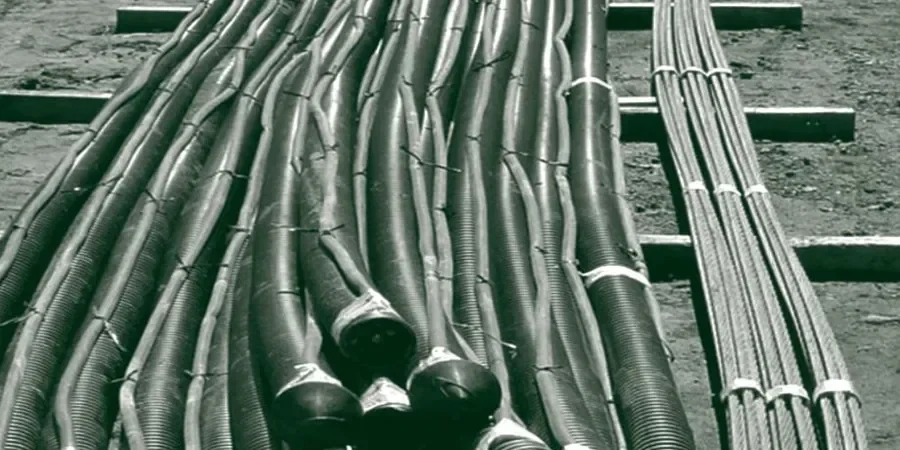
Prestressed strand or bar anchors with defined free and fixed lengths. Suitable for retaining walls, bridge abutments, and structures where movement must be limited to millimetres. Includes bond-length verification against site-specific ground conditions.
Passive Anchor (Soil Nail) Design
Self-drilling hollow-bar systems installed without prestressing. Ideal for temporary excavations in Wolverhampton's glacial till and for slopes where the failure surface is shallow. Particularly effective where cobble-rich ground complicates casing installation.
Anchor Load Testing
On-site proof testing to BS 8081 acceptance criteria, including lift-off checks, creep monitoring, and extended-duration tests for permanent anchors. Digital load cells and displacement transducers record full test curves for submission to building control.
Mining Risk Anchor Review
Desktop Coal Authority search combined with rotary probing ahead of anchor installation. Determines standoff distances, grout-loss monitoring protocols, and contingency designs for anchors encountering unrecorded workings in the Coal Measures.
Typical parameters
Top questions
What is the difference between active and passive anchors?
An active anchor is prestressed against the structure after installation—think of it as tightening a bolt to lock everything in place before any load is applied. A passive anchor, by contrast, only develops its force once the ground starts to move. In Wolverhampton, active anchors are specified where deflection tolerance is tight, while passive soil nails are common for temporary excavations where a few millimetres of movement is acceptable.
How much does anchor design and testing cost?
The combined design, installation specification, and on-site load testing typically falls between £830 and £2,940 depending on the number of anchors, the corrosion protection class required, and whether mining-risk probing is needed. A single permanent anchor with full CP4 protection and extended creep testing will sit at the upper end of that range.
How do you account for old mine workings when designing anchors?
We cross-reference the Coal Authority’s mining records with the site investigation data, then carry out rotary open-hole probing at each anchor location before installation begins. The probe hole extends at least 3 metres beyond the planned fixed-anchor zone. If a void or broken ground is detected, we relocate the anchor and adjust the wall geometry accordingly.
What load test is required for a permanent anchor in Wolverhampton?
BS 8081 requires a proof load to 1.25 times the working load for every anchor, with creep monitored over a minimum 15-minute hold period. For permanent anchors in aggressive ground—common in Wolverhampton’s former industrial areas—we also recommend one sacrificial anchor per project taken to 1.5 times working load to confirm the ultimate bond capacity has adequate margin.