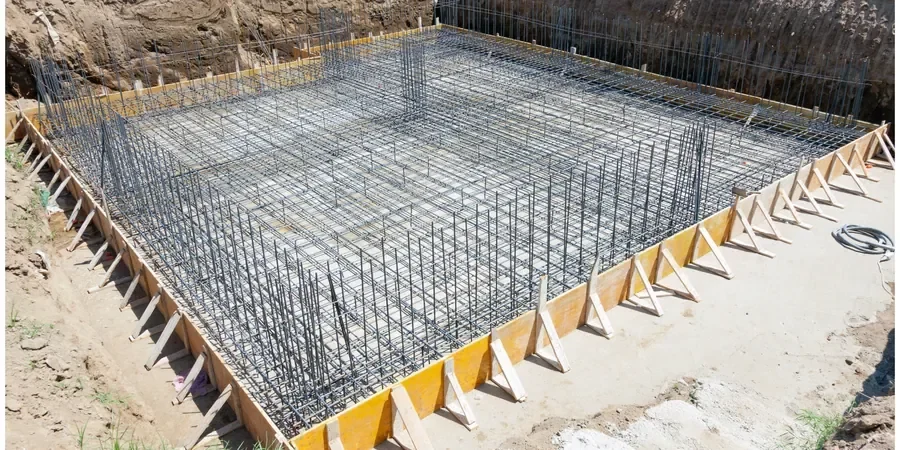
Wolverhampton sits on a varied geological transition, where Bunter Sandstone gives way to Carboniferous coal measures and pockets of glacial till. These shifts create a patchwork of ground conditions that can change within a single site. A conventional strip or pad footing design is often not enough when dealing with low-bearing alluvium along the Smestow Brook corridor or made ground from the city’s industrial past. Raft and mat foundation design addresses this directly by spreading structural loads across a larger footprint, reducing differential settlement in soils that lack uniformity. The sand cone density test is frequently specified during our pre-construction phase to verify the compaction of any engineered fill before a raft is cast, ensuring the bearing stratum behaves as assumed in the design model.
A raft foundation is not a default choice. It is an engineered response to ground that refuses to behave. We model it as a structural slab on a deformable half-space.
Method and coverage
Regional considerations
The risk profile for a new build in the Penn Road area differs sharply from a plot in Heath Town. Penn Road may encounter stiff, overconsolidated glacial till that offers good bearing but swells with seasonal moisture change. Heath Town, closer to the old Wednesfield industrial belt, often sits on deep made ground with uncompacted ash and brick rubble. A raft foundation acts as an insurance policy in both cases, but the design inputs are worlds apart. The biggest threat we see is an inadequate ground investigation that misses a lens of soft clay or a forgotten culvert. When a raft is placed over a variable substrate, differential settlement can exceed the angular distortion limit of the brickwork above, leading to cracking that is expensive and difficult to remedy. We push for a minimum of one borehole per 200 m² on complex sites, supplemented by dynamic probing to confirm refusal depth across the raft footprint.
Process video
Standards that apply
BS EN 1997-1:2004 + A1:2013 (Eurocode 7: Geotechnical design), BS EN 1992-1-1:2004 + A2:2014 (Eurocode 2: Design of concrete structures), BS 8004:2015 (Code of practice for foundations), BS 5930:2015 + A1:2020 (Code of practice for ground investigations), BS 1377-9:1990 (In-situ tests: plate bearing test)
Related services
Geotechnical Interpretative Report
Synthesis of all ground investigation data into a design soil profile with characteristic values for strength and stiffness parameters, prepared in accordance with Eurocode 7 principles.
Settlement and Bearing Analysis
Calculation of total and differential settlement under SLS loads using elastic half-space methods, with verification of bearing capacity for the ultimate limit state.
Raft Structural Design and Detailing
Finite element modelling of the raft slab including soil springs, reinforcement scheduling for flexure and punching shear, and thermal crack control detailing to BS EN 1992.
Construction Phase Support
Review of subgrade preparation, compaction testing acceptance criteria, and resolution of unexpected ground conditions encountered during excavation.
Typical parameters
Top questions
When does a raft foundation make more sense than deep piles in Wolverhampton?
A raft becomes the logical choice when the competent bearing stratum is too deep for economic strip footings but shallow enough that a piled solution would be over-engineering the problem. If we have a stiff clay or weathered sandstone within 2 to 3 metres of the surface and the structural loads are modest, a raft typically costs less than piling and avoids the noise and vibration issues that concern neighbours on tight urban sites.
What is the typical cost range for a raft foundation design package in the West Midlands?
For a complete design package covering the geotechnical interpretative report, settlement analysis, and structural detailing of the raft, the fee generally falls between £880 and £3.070. The spread depends on the number of boreholes to interpret, the complexity of the soil profile, and whether the project requires a full 3D finite element analysis or a simpler 2D strip model.
How do you determine the subgrade reaction modulus for a raft design?
We prefer to back-calculate the modulus of subgrade reaction from a plate load test conducted on site, as specified in BS 1377-9. When a plate test is not available, we derive the spring stiffness from the constrained modulus obtained via oedometer testing on undisturbed samples, adjusting the value for the size and shape of the full raft using established soil-structure interaction theory.
Can a raft foundation be designed for a site with a history of shallow coal mining?
Yes, but the design must incorporate a rigorous assessment of the mine workings. We commission a coal mining risk assessment and, where voids are suspected within the zone of influence, we design the raft to span potential crown holes. This often means increasing the slab thickness and adding a double layer of reinforcement to supply redundancy. The raft acts as a reinforced bridge over any small collapse that might occur.