The geology beneath Wolverhampton tells two very different stories. North of the city centre, glacial till and sandy clays overlie the Bunter Pebble Beds; head south towards Sedgley Beacon and the Silurian limestone and shale outcrops change the ground behaviour entirely. A fill that achieves 95% relative compaction on one site may barely reach 88% on another just two miles away. That contrast is why we run the Proctor test early—before mass earthworks begin. The Standard or Modified Proctor, selected according to the plant being used on site, gives us the maximum dry density and optimum moisture content that every roller operator needs. We see too many jobs in the West Midlands where compaction is treated as a tick-box exercise; our laboratory treats it as a verification of material suitability, and when the fill comes from variable local borrow pits, the grain-size analysis we run in parallel often explains density shortfalls that a compaction curve alone cannot diagnose.
A two percent moisture deviation from optimum can cost you five percent of your target density—and in Wolverhampton's variable fills, that gap opens fast.
Method and coverage
Regional considerations
The Triassic sandstones and pebble beds underlying much of Wolverhampton weather to a sand-clay mix that is highly moisture-sensitive. A change of just two percent moisture content can drop the achieved dry density below 95% relative compaction, especially on the silty fine sands found in the Smestow Valley corridor. What complicates compaction on brownfield sites across the city—and there are many, from former foundries to cleared industrial plots off the Bilston Road—is the presence of ash, clinker, and brick fragments that produce Proctor curves with an almost flat top. On those materials the optimum moisture content is a range, not a point, and the roller operator needs clear guidance on the acceptable moisture window. Running the Proctor test on a truly representative sample, not a grab bag from the stockpile surface, is the single most important step in making the result useful. We reject samples that arrive dried out or segregated, because a compaction curve generated from non-representative material misleads the whole earthworks operation.
Standards that apply
BS 1377-4:1990 – Compaction-related tests, BS EN 1997-2:2007 (Eurocode 7) – Ground investigation and testing, Specification for Highway Works, Series 600 – Earthworks
Related services
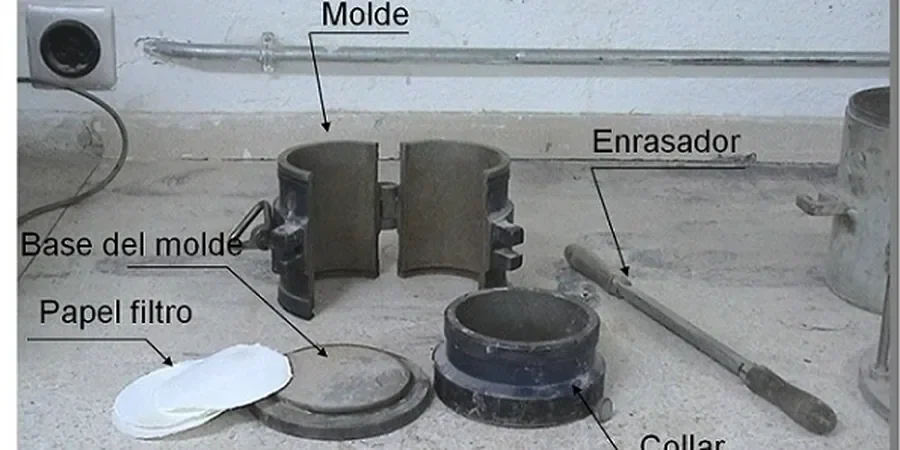
Standard Proctor (2.5 kg Rammer)
For fine-grained soils and typical residential or light commercial earthworks. We follow BS 1377-4 using the 2.5 kg rammer and 300 mm drop, providing the reference density curve that site density tests are measured against.
Modified Proctor (4.5 kg Rammer)
Specified for heavy highway embankments, airfield pavements, and deep fills where modern vibratory rollers achieve higher compactive effort. The 4.5 kg rammer with a 450 mm drop replicates the energy input of heavy plant operating on site.
Compaction Verification Package
A combined service: we run the Proctor curve, then test your site samples for moisture content and dry density. We overlay the in-situ point onto the laboratory curve and issue a single report with pass/fail commentary against the specification target, typically 95% or 98% relative compaction.
Typical parameters
Top questions
How much does a Proctor test cost in Wolverhampton?
A single-point Standard or Modified Proctor test typically ranges from £90 to £150, depending on whether we are testing a single bulk sample or running a full five-point curve. Compaction verification packages combining the Proctor curve with site moisture and density determinations are quoted per project; contact the lab with your specification and number of samples for a fixed-price proposal.
Should I specify Standard or Modified Proctor for my Wolverhampton site?
It depends on the earthworks specification and the compaction plant planned. For road embankments, large commercial platforms, or any fill exceeding 2.0 m thickness where vibratory rollers are used, the Modified Proctor (BS 1377-4, 4.5 kg rammer) is standard practice under Specification for Highway Works Series 600. For landscaping, service trenches, and low-rise residential footings on recompacted natural ground, the Standard Proctor is usually sufficient. We are happy to review your project specification and advise which test aligns with the required end-product performance.
How soon can I get results for a Proctor test?
Standard turnaround is three to four working days from sample receipt. We can process urgent samples in 48 hours for projects on critical programme paths—just let us know the deadline when you submit the material. The main time driver is oven drying each compaction point to constant mass; we run two ovens continuously to handle parallel workloads.