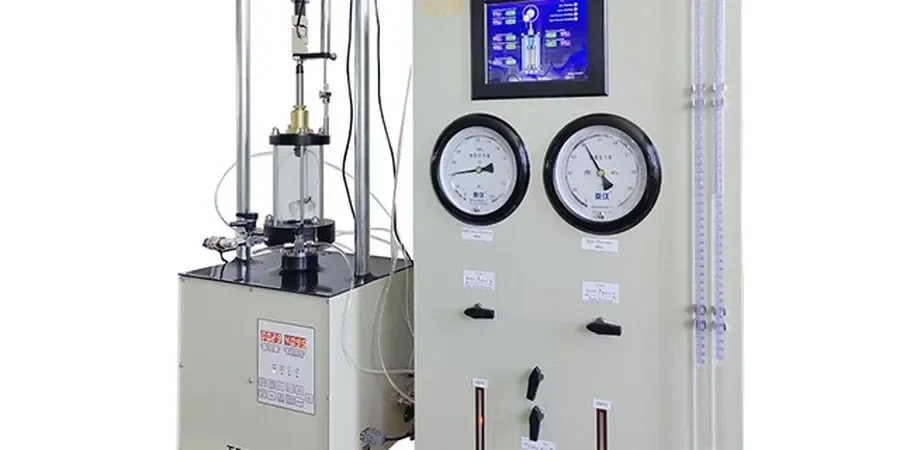
Wolverhampton's geology presents a complex sequence of Permian and Triassic sandstones, locally overlain by glacial till and alluvial deposits along the River Smestow and Staffordshire & Worcestershire Canal corridors—materials whose drained and undrained shear strength can vary dramatically across a single site. A triaxial test provides the controlled stress-path data that direct shear or index tests simply cannot replicate, measuring how these soils behave under the combined influence of confining pressure and deviatoric loading. For foundation bearing capacity calculations under BS EN 1997-1 and slope stability analyses in the Pennant Sandstone weathered zones, the effective stress parameters (c' and φ') derived from a properly executed triaxial programme are not optional extras but essential inputs. We routinely conduct consolidated-undrained (CU) and consolidated-drained (CD) triaxial testing at our ISO/IEC 17025 accredited laboratory, processing specimens extracted from rotary cores taken across the city's characteristic Mercia Mudstone and Kidderminster Formation strata.
The triaxial test remains the only laboratory method capable of measuring pore pressure response during shear—a parameter that governs effective stress and cannot be obtained from index testing.
Method and coverage
Regional considerations
At an elevation of roughly 163 metres above ordnance datum with a population exceeding 260,000, Wolverhampton's development pressure increasingly pushes construction onto marginal ground where triaxial testing is most critically needed. Underestimating the effective friction angle of a dense sand by even two degrees—an error easily introduced by relying on SPT correlations calibrated for different geological formations—can reduce the calculated bearing capacity by 15-25%, pushing foundation dimensions beyond economic limits or, worse, leaving the structure with an unquantified margin against shear failure. The Mercia Mudstone, prevalent across the West Midlands, presents a particular challenge: its diagenetic bonding can produce triaxial peak strengths that degrade significantly with weathering or stress relief during excavation, a phenomenon detectable only through consolidated-drained testing with post-peak strain measurement. For earthworks on the city's steeper slopes near Tettenhall Ridge, a solid triaxial testing programme provides the shear strength envelope that slope stability models require to demonstrate adequate factors of safety under both drained and undrained groundwater conditions.
Process video
Standards that apply
BS EN ISO 17892-8:2018 – Geotechnical investigation and testing – Laboratory testing of soil – Part 8: Unconsolidated undrained triaxial test, BS EN ISO 17892-9:2018 – Geotechnical investigation and testing – Laboratory testing of soil – Part 9: Consolidated triaxial compression tests on water-saturated soils, BS EN 1997-2:2007 – Eurocode 7: Geotechnical design – Part 2: Ground investigation and testing (with UK National Annex)
Related services
Multi-Stage Triaxial Testing
A single specimen is sheared at increasing confining pressures to define the failure envelope efficiently, particularly useful for Wolverhampton sites with limited sample recovery from the Mercia Mudstone or Carboniferous sandstone. Each stage is terminated before peak stress, preserving specimen integrity for the subsequent consolidation stage.
Consolidated-Drained (CD) Triaxial with Stress Path Control
Slow-drained testing with pore pressure monitoring to determine effective stress parameters (c', φ') for long-term stability analyses. Stress path control allows simulation of specific construction sequences—excavation unloading, embankment loading—relevant to the canal corridor earthworks that characterise Wolverhampton's industrial periphery.
Typical parameters
Top questions
How much does a triaxial test programme cost for a typical Wolverhampton site?
A programme of three consolidated-undrained (CU) triaxial tests with pore pressure measurement, including specimen preparation and reporting to BS EN 1997-2, typically ranges from £1,710 to £2,410 depending on specimen diameter, confining pressure requirements, and whether multi-stage testing is specified. Consolidated-drained (CD) tests with stress path control fall at the upper end of this range due to extended test duration. We supply fixed-price quotations based on the specific testing schedule required for your foundation design.
What is the difference between UU, CU and CD triaxial tests, and which one do I need?
Unconsolidated-undrained (UU) tests supply undrained shear strength (cᵤ) for short-term stability in fine-grained soils where construction loading is rapid relative to consolidation time. Consolidated-undrained (CU) tests with pore pressure measurement yield effective stress parameters (c', φ') for both short and long-term assessment and are the most commonly specified for Wolverhampton foundation design. Consolidated-drained (CD) tests are reserved for free-draining granular soils or for determining the critical state friction angle in slope stability analyses where long-term drained conditions govern. Your geotechnical engineer should select the appropriate test type based on the design situation and soil permeability.
How long does triaxial testing take from sample delivery to final report?
Standard turnaround for a CU triaxial programme of three specimens is approximately 10-14 working days from receipt of undisturbed samples. Consolidated-drained (CD) tests extend this to 15-20 working days due to the slower shear stage required for pore pressure dissipation. The laboratory report includes all raw data, Mohr-Coulomb plots, stress-strain curves, pore pressure response graphs, and a factual summary of the derived parameters. Expedited schedules can often be arranged for time-critical Wolverhampton projects.
What sample quality is required for a reliable triaxial test result?
Triaxial testing demands undisturbed samples of Category A quality per BS EN 1997-2, typically obtained from thin-walled Shelby tubes, piston samplers, or block sampling in trial pits. Disturbed samples or those showing signs of desiccation, fracturing, or sampling-induced remoulding will produce unrepresentative strength parameters. For Wolverhampton's Mercia Mudstone and glacial till, U100 open-drive samples are generally adequate provided they are sealed immediately on extraction and transported to the laboratory in rigid containers. We assess every specimen on arrival and communicate any concerns about sample quality before proceeding with the testing programme. More info.