The Black Country’s industrial past left Wolverhampton with a complex geological puzzle. Variable glacial till, pockets of soft alluvium along the Smestow Brook, and historical coal mining voids all sit beneath the city’s brick terraces and new housing estates. Foundation design here is never a copy-paste exercise. A shallow foundation scheme must account for sudden changes in bearing strata, often within the footprint of a single house extension. The team analyses site investigation data against the specific requirements of Eurocode 7 (BS EN 1997-1:2004) to define a safe bearing pressure. Where fill is encountered, we often recommend a test pit programme to visually log the material before finalising the pad or strip geometry. For larger commercial plots on the city’s northern expansion areas, integrating CPT data helps identify thin weak layers that boreholes might miss. Wolverhampton’s reactive clay subsoils also demand careful assessment of seasonal volume change potential to prevent differential movement in lightly loaded foundations.
A shallow foundation in Wolverhampton succeeds when the design respects the glacial till’s variability, not just the average SPT N-value.
Method and coverage
Regional considerations
The biggest risk in Wolverhampton is unrecorded shallow mine workings. The city sits on the South Staffordshire Coalfield, and bell pits or abandoned shafts can exist beneath sites that appear perfectly level. A shallow foundation designed without a proper desk study and intrusive investigation can fail catastrophically if a void migrates to the surface. Coal Authority reports are mandatory, but they don’t always capture every 19th-century working. The ground investigation must therefore include targeted rotary drilling to prove rockhead integrity. A second risk is clay heave following tree removal. Many Wolverhampton suburbs, from Penn to Finchfield, have mature oak and willow trees. Removing them can cause the underlying clay to swell over several years, lifting a shallow foundation and cracking the superstructure. The design mitigates this by specifying void formers or deeper, sleeved foundations where necessary. Ignoring these local hazards leads to structural distress within the first five years, a pattern we’ve seen repeatedly in local insurance claims.
Standards that apply
BS EN 1997-1:2004 (Eurocode 7, part 1), BS 5930:2015+A1:2020 (Site investigation code), NHBC Standards Chapter 4.2 (Building near trees), BRE Digest 240 & 241 (Low-rise on shrinkable clay)
Related services
Bearing Capacity Calculation
Analytical and numerical assessment of ultimate and allowable bearing pressure for pad and strip foundations, applying the UK National Annex partial factors to BS EN 1997.
Settlement Analysis
Immediate and consolidation settlement prediction using elastic half-space and oedometer-derived parameters. Serviceability limit state checks for all foundation elements.
Foundation Layout & Detailing
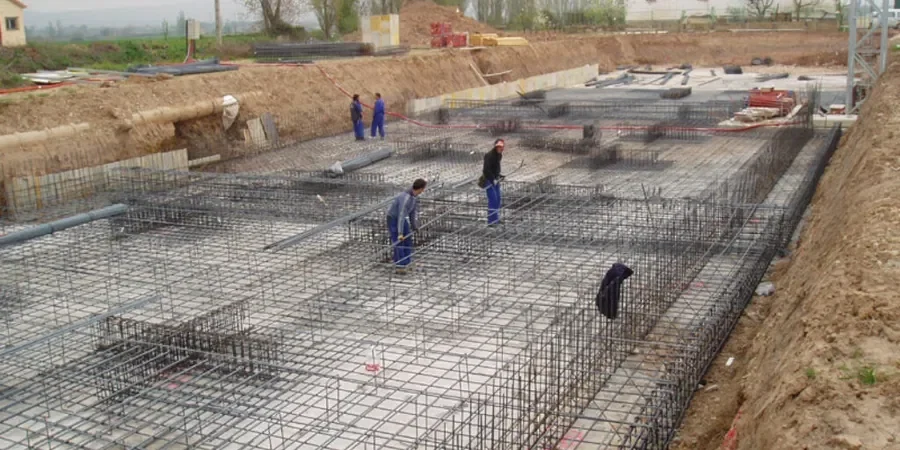
Dimensioning of reinforced concrete strips and pads, step details for sloping sites, and specification of anti-heave measures for shrinkable clay profiles common across Wolverhampton.
Typical parameters
Top questions
What depth of shallow foundation is typical in Wolverhampton's glacial till?
Most strip foundations in the area are taken to a minimum depth of 900 mm below ground level to avoid the active zone of seasonal moisture change. In glacial till, this depth often reaches competent, stiff clay with an undrained shear strength exceeding 75 kPa, but the exact depth is confirmed by trial pitting or window sampling on each plot.
What does a shallow foundation design cost for a typical Wolverhampton house extension?
For a single-storey or two-storey rear extension, the design package, including bearing capacity and settlement checks with a full Geotechnical Design Report, falls between £1,500 and £2,320. The final figure depends on the complexity of the ground conditions and whether additional investigation like lab testing of the clay is required.
Can I use a shallow foundation if the Coal Authority report shows past mining?
It depends on the depth and condition of the workings. If the competent rockhead is within a few metres and the mine seams are deeper, a reinforced raft or wide strip foundation can often be adopted. The design must incorporate a rockhead integrity assessment from rotary coring and a signed-off mining risk assessment before proceeding.